Showing posts with label technology. Show all posts

Sunday, 17 January 2016

Fluid Mechanics

Prerequisite: physics 1, algebra 2

All things "flowable" are fluids, which may be liquids, gases, plasmas, ion soups.. but for now, liquids and gases. Specific gravity is the ratio of two substances' densities, which comes in handy with buoyancy.

One main property that fluid mechanics considers is pressure. Here are two laws of fluid statics, regarding pressure of stationary fluid on an object:


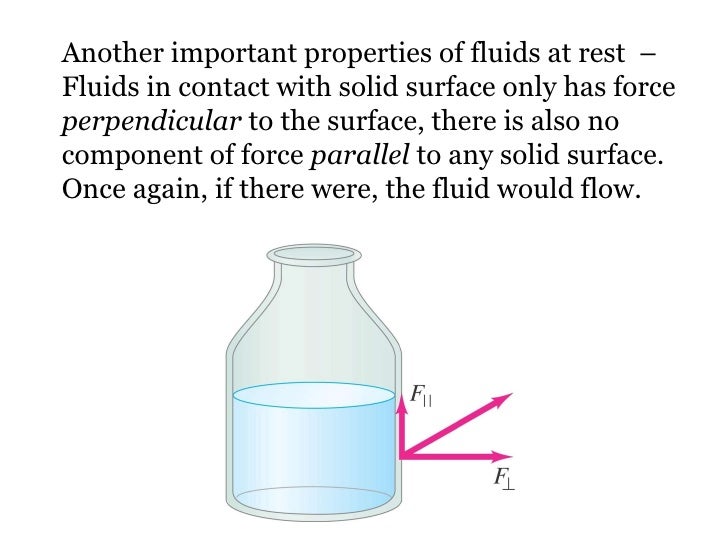
The first one is quite understandable, since pressures need to be uniform in order for fluids to be stationary. The second one is somewhat confusing, but the logic is that since nothing is moving, the net force must be zero. Backwards reasoning. Sorry for the misleading picture, here is a better one:


There are many explanations out there from torque to average force, but my understanding is this: force is acceleration times mass, so if a fluid exerts a diagonal force as shown above, the fluid mass is accelerating with a y component and therefore moving. In order for the fluid to not be moving, it can only accelerate horizontally against the rigid bottle.

A more detailed formula for pressure can be derived as follows:

P = F / A
    = (mg) / A
    = (DV)g / A
    = D(l*w*h)g / (l*w)
    = Dhg
    = Dgh

This formula is for incompressible fluids, in other words, fluids that have the same density at any depth. For compressible fluids, ∆P = Dg∆h.


 Another common formula is this:


Atmospheric pressure is obviously pressure due to the atmosphere. Absolute pressure is the pressure inside a container regardless of the outside pressure. Gauge pressure is in a sense the "net pressure".

But I rather like to think of it as P(atm) - P(abs) = P(g), in which the pressure balance between the outside and inside determines the "apparent pressure" P(g). Dunno. Makes more intuitive sense to me.

Pascal's Principle is applied in the hydraulic lift in which since the pressure is the same at both ends, the out force increases with a maximized area so that the pressures match. The increased force can then be used to lift objects.


In terms of work, the in force is smaller but needs to cover a greater distance, in order for the greater out force to cover a short distance. No glitches, hacks, nor dirty tricks. Just physics.

Another property that fluid mechanics studies is buoyancy, the ability of an object to float. By Archimedes' Principle, an object's buoyant force is the weight of displaced fluid. If you divide constant g from both sides, you have D(fluid)V(displacement) = DV of object.


In fluid dynamics, flow rate can be expressed in mass over time, and if density does not vary, volume over time. The volume rate is easier to visualize while the mass rate uses density to convert volume units into mass units.


And here, Bernoulli's Principle: pressure is inversely proportional to pressure. I like to think of it as driving, or traffic. The cars are mashed up together in the slow lane but widely spaced out in the fast lane. Planes can fly because the bumps in their wings cause air to flow at a greater velocity over the wing than under, so the pressure is greater under than over, then lift off~ And there, the equation is derived by setting work and ∆PE equal to ∆KE.


So there, the basics of fluid mechanics~

Sunday, 20 December 2015

Ai Pioppi

Prerequisite: physics, algebra 2/geometry

The Bicycle of Death. I bet it sounds more menacing in Italian. It is one of the many human-powered rides at Ai Pioppi.

This ride just about sums up my second quarter of AP Physics but I am not supposed to go into that, am I? The Blue Giraffe is protesting now. But I must comment on how much energy goes to friction and moving the hardware itself! While it is tough work for two men, two children would be dealing with even greater percentages of their body masses. It is almost a fancy workout equipment.

But then that is the power of machines, pedalling a greater arc length for moving a shorter arc length along the track.

I see there is also an extension from the carriage, through the center of the circle, to the other side. It may contribute as a counter mass of the carriage to facilitate riding towards the top, and as an inertial mass to uhh, keep people hanging up there.

F = Ia here refers to the weight of this counter mass (the acceleration should have been called g tangent).


I have not quite labelled everything thoroughly, missing a couple tangent subscripts here and there, but whatever. And I put zero at the top. And I should be using degrees in physics. Meh. Point is, gravity does some of the work.


It is also interesting to note the carriage's gradual accumulation of height. This ride makes a visual for the net accumulation of energy, of human input and friction output. And each time the carriage passes through ground level, it does so at a higher speed.

The place has come a long way from welding seesaws and roundabouts for little kids..

Wednesday, 14 October 2015

Quantum Cryptography


Prerequisite: physics

Modular functions seems impregnable enough but cryptographer just had to take it one step further, harnessing the random unpredictability of light polarization.

Photons can travel as transverse waves. What a polaroid does is filter out waves that oscillate in other directions. Some polaroids allow many oscillation directions while in this diagram below, the polaroid filters out all light waves except ones that oscillate vertically.. but not really.


Diagonal waves have a 50% chance of passing the filter and becoming vertical at the other side, according to Schrödinger's concept of superposition. Another key feature is that one cannot directly observe the polarization of photons due to Heisenberg's uncertainty principle, but one knows for sure the polarization of photons that come after a polaroid.

Let the madness begin.

As a setup for an example of quantum cryptography:

Message is translated into binary.
For the sake of simplicity, assume four possible wave polarizations.
Vertical ( | ) and horizontal ( - ) waves can pass through rectilinear polaroids (+).
Diagonal waves ( / and \ ) can pass through diagonal polaroids (x).
( | ) and ( / ) represents 1.
( - ) and ( \ ) represents 0.

Alice wants to send a key to Bob, and comes up with a pre-key 10011011.
She sets a scheme of randomly alternating polaroids +x++xx+x, then sends polarized photons ( | \ - | / \ | / ) through specific |, -, /, and \ polaroids to Bob, accordingly with her scheme.

A summary of Alice's transmission:

pre-key:         1 0 0 1 1 0 1 1
scheme:         + x + + x x + x
polarization:   | \  -  |   / \   |  /

(The only way to detect the polarization of a photon is by trial and error, where there is only one trial. Eve cannot possibly guess which polaroid to use for an upcoming photon, and using the wrong one will either block out or repolarize a photon, neither of which are desired. She cannot even deduce whether she used the correct polaroid or not, since a photon entering an incorrect polaroid has a 50% chance of getting through. Tampering with the photons with polaroids can also reveal Eve's act of eavesdropping).

Bob on the other end tries to receive the photons with a random polaroid scheme of his own.
Alice and Bob then identify where they used the same scheme, which is also where they both know the correct polarizations, and the resulting fragmented sequence can be used to generate their key (1110 in this example):

pre-key:                     1 0 0 1 1 0 1 1
Alice's scheme:         + x + + x x + x
polarization:               | \  -  |   / \   |  /
Bob's scheme:           + + x + x x x +
filtered scheme:        +        + x x
key:                           1        1 1 0

Eve can overhear what schemes they filtered out, but she cannot know what Bob correctly observed, which is essentially the key. The only way for Eve to know the key is to use the exact same scheme as Bob, which is highly improbable when the key is extremely long.

The incorporation of photons started with Charles Bennett's idea of quantum foolproof money. Last time I checked, a quantum key was successfully exchanged over one kilometer.

Oh dear mortals, what next?

Monday, 12 October 2015

Modular Functions in Encryption

Followup of Code Decryption

Prerequisite: algebra

The toughest of ciphers in Code Decipherment are not impregnable, because algorithms can be thought of as a function. No matter how complex the procedure, the systematic nature gives it away and like algebra, functions can be worked backwards.

Another problem is with key distribution. For the recipient to be able to decrypt a message, the recipient must have the key as well. This is particularly significant to digital communications where the key cannot simply be handed over in person (which defeats the purpose of digital communication!). To send the key digitally requires another key to secure the first key, and another for the second.. like an infinite Matryoshka doll. No way.

The thing to do then, is to 1) find an irreversible function and 2) find a way to decrypt a message without exchanging keys.

The breakthrough idea was formed separately first by James Ellis, Clifford Cocks, and Malcolm Williamson, then Whitfield Diffie, Martin Hellman, Ralph Merkle, Ronald Rivest, Adi Shamir, and Leonard Adleman. The concept can be described with the following analogy:

Alice is trying to send a message to Bob while Eve is eavesdropping.
Alice puts her message in a box.
Alice puts lock A on the box using key A, which she keeps secret.
Alice sends the box to Bob.
Eve cannot open the lock A on the box.
Bob puts another lock B on the box using another key B, which he keeps secret.
Bob sends the box back to Alice.
Eve cannot open lock A and B on the box.
Alice unlocks lock A using key A
Alice sends the box back to Bob.
Eve cannot open lock B on the box.
Bob unlocks lock B using key B.
Bob opens the box and reads Alice's message!

This solves the key distribution problem since no keys are exchanged, but it requires the function to be commutative as well as irreversible. So what kind of function fits the description?

The modular function~

There are two ways to understand it. One is to think of it as a clock. 12 (mod 7) = 5 would be 12 jumps around a 7 hour clock, landing at 5. Another way is to take 12 divided by 7, then state the remainder 5.


The following example applies modular functions not as an algorithm of the message itself, but as the algorithm to exchanging keys.. without exchanging keys:

Alice and Bob agree on a the function 3^x (mod 7) = y.
Eve overhears this function.
Alice chooses 6 as her key A, solves 3^(6) (mod 7) = 1, and reports the answer "1" to Bob.
Bob chooses 10 as his key B, solves 3^(10) (mod 7) = 4, and reports the answer "4" to Alice.
Eve overhears the exchange "1" and "4" but cannot reverse them with the function or do anything.
Alice solves B^A (mod 7), which (4)^(6) (mod 7) = 1.
Bob solves A^B (mod 7), which (1)^(10) (mod 7) = 1.
And so "1" is the agreed key for their message!
(I should have chosen better numbers where in reality the numbers are veeeeeeery large and do not coincide)

One may reverse the function through rigorous trial and error, but it is simply too exhausting when the key can reach astronomical lengths. The way to encrypt messages directly is as follows:

Alice choose two veeeeery laaaaarge prime numbers p and q, which she keeps secret.
Alice multiplies the two numbers to get N, and picks another number n. These two numbers she announces as a public key.
Bob wants to send Alice the letter "B", which he has to digitize first with ASCII binary digits or something.
Bob uses Alice's public keys to encrypt his letter "B" with the formula B^n (mod N) = C, solves for C, and sends it to Alice.
Eve overhears the message C but cannot do anything with it, not even with Alice's public keys since modular functions are not reversible.
Alice solves for a private decryption key d with the formula nd = 1 (mod (p-1)(q-1)) using Euclid's Algorithm (whatever that is).
Alice then deciphers Bob's message with the formula C^d (mod N) = B to get B.

It only gets crazier when you cross cryptography with physics. Just you wait. Be prepared to encounter some photons in a followup post..

Code Decryption

Prerequisite: algebra

Been reading The Code Book: The Science of Secrecy from Ancient Egypt to Quantum Cryptography by Simon Singh. It is a very fascinating read between history, cryptography, and linguistics. In this post I compile some deciphering techniques. Some are simple while others are pure genius. But first, some terminology.

plaintext: original message (notated in lowercase)
ciphertext: enciphered message (notated in capitals)
algorithm: the method of enciphering a message
key: the premise of an enciphering method


A person needs to know both the algorithm and the key in order to decipher a ciphertext. But in many cases, the algorithm is obvious and the key can be traced from it.

Alphabetic Substitution

This is the simplest of algorithms where the alphabet is scrambled up to make a cipheralphabet. A good knowledge of English (or whatever the plaintext is written in) is enough to crack the ciphertext.

If a lone alphabet appears commonly throughout a ciphertext, one can deduce that is either "a" or "i". Similarly, a recurrence of a three letter cipherword is probably "and" or "the". If there is no vowel in a four letter cluster, one of the letters is probably a "y". The letter after the "q" must be a "u". If the spaces are eliminated, one can still guess common suffixes for a start. Lingual rules provide many handholds to decipherment.

Know your spelling rules, substitute what you can, and play a little hangman until you get the whole plaintext. That was how I cracked the Gnommish Alphabet in the Artemis Fowl series back in seventh grade.

Caesar Shift

Actually I lied. The Caesar Shift is even simpler. It shifts the alphabet several places, then uses it as the cipheralphabet. The number of shifts is agreed with the recipient beforehand.


This encipherment was used for extremely short messages, such as one phrase. There are not enough clues to reason with, but this is still a weak cipher considering that one only needs to test twenty six cipheralphabets at most to reach the plaintext. If that sounds like a lot of work to you, read on. You will much rather confront a Caesar Shift.

Vigenère Cipher

"The Indecipherable Cipher" utilizes the Vigenère Square, which is essentially all possible Caesar Shifts lined systematically to make a square:


What happens is that the sender and receiver agree on a keyword, such as "BLUE". To encipher a message, the first letter would be enciphered with the Caesar Shift starting with "B", the second letter with the shift starting with "L", the third with the shift starting with "U", the fourth with "E", and the fifth with "B" again. So the message "pig is hungry" enciphered with the keyword "BLUE" will be "QTAMTSORHCS".

B L U E B L U E B L U
p  i  g  i  s  h u n g  r  y
Q T A MT S O RH C S

This enciphering technique is a polyalphabetic cipher, which alternates between more than one cipheralphabet. This makes it harder to pick out letters by frequency as opposed to a monoalphabetic cipher, where you can almost guess correctly that the most common cipherletter probably represents the plainletter "e".

Charles Babbage figured that frequency analysis plays a big role concerning the nature of Caesar Shifts in the Vigenère Cipher. Arabs first came up with frequency analysis, the association of cipherletters with plainletters by occurrence. What happens is you get an graph describing the frequency distribution of alphabets in a language..


..then compare it to the frequency distribution of cipherletters in your ciphertext (similarly can be done with Zipf's Law for whole words). Match corresponding frequencies of letters and cipherletters, substitute, do some tweaking, and you should have the plaintext. This technique is not particularly significant for general Alphabetic Substitution since logical reasoning is enough to crack the cipher, but it gives a handhold in Vigenère decipherment.

Homophonic Cipher

The previous ciphers were especially vulnerable to letter frequencies. To make up for that, the homophonic cipher uses numbers as the cipheralphabet, and adds more cipherletters to even out the frequencies. Each cipherletter should appear just as often as another.


It takes much more thought to crack this cipher, but it is still possible. One can consider spelling rules, estimate the amount of extra cipherletters for each plainletter, and take both into account. There is much more trial and error, but it is not such a horror compared to the next cipher..

The Enigma

This is where encryption escalates quickly. Why read my words when you can see for yourself? This video on the Enigma Machine tells what you need to know.

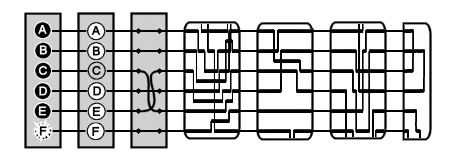
Hooooo, what is this monster? From left to right, the machine components are lamp letters, keyboard, plugboard, first scrambler, second scrambler, third scrambler, and reflector. If you trace this diagram carefully, hitting the "C" key gives the output "F".


The Germans with their Enigma Machines changed their agreed scrambler setting everyday in order to securely encipher the scrambler setting of their actual messages. So a person receiving a message would set their Enigma Machine to the agreed day setting, decipher the new scrambler setting, set to the new setting, and then proceed to decipher the actual message. The plugboard setting stays the same.

The Machine is the algorithm and the scrambler setting is the key. The key is six letters long, where the first three are the starting letters of the scramblers and the last three is a repetition. The key in plaintext "pigpig" may be enciphered as "GXWLDN".

To obtain the key, Marian Rejewski cleverly mapped out the chains of letter relations. He analyzed numerous keys of one day setting and paired up the first and fourth letters of each six letter key, since they are repetitions of each other. A relation for A, B, C, D, E, and F can be:

A B C D E F
D A F E B C

Then he organized this relation into chains. In this example there are two separate chains:

four links: A --> D --> E --> B --> A
two links: C --> F --> C

The significance of this organization is that the plugboard cannot interfere with the amount of chains or links, so that it is useful for cracking the scrambler setting. Instead of finding one key among ten thousand million million keys, he had only 105,456 possible chain-link characteristics to consider. And then there was the manual labour of recording the number of chains and links for each scrambler setting, but they did it. It took a year.

When the Germans found out about their flaw they stopped repeating their keys. To find the key, Alan Turing used Rejewski's idea on cribs. A crib is a ciphertext in which you know its plaintext as well, which in their case had to be guessed. A common crib that the Germans provided was "weather" (or "wetter" in German) in their weather reports.

Then he had to figure some plugboard settings as well. The trial and error went something like this:

He had some data based on a crib.
Given that ciphertext "A" is plaintext "b",
assume that "A" is connected to "S" on plugboard.

A --> plugboard --> S --> scramblers --> ? --> plugboard --> b
A --> plugboard --> S --> scramblers --> F --> plugboard --> b

So he joined "A" to "S" on the plugboard, then saw which letter lighted up. If "b" lighted up, it shows that "b" is not connected to any letter on the plugboard. If "F" lighted up, which he knew should be "b", he then assumed that "F" is connected to "b".

All that is good, but what happens when there is a contradiction? Say, three letters seem to be plugged to each other. Yes, those would be incorrect deductions from an incorrect assumption. To turn mistakes into an advantage, Turing realized that all these incorrect deductions are definitely incorrect, and do not need to be tested further. I am still trying to get my head around this one.

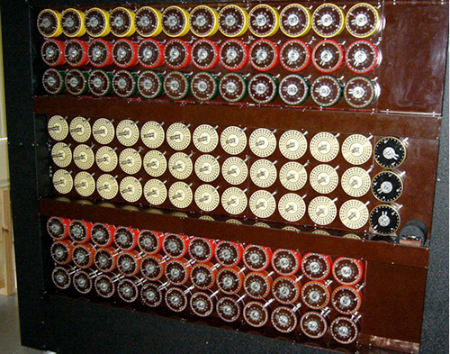
And he threw these testings into a bombe.


For more historical context alongside the logic, you ought to read The Code Book. It is pleasant for leisure as well as for study. If this article makes you insecure about your internet privacy, I have another post coming up that will calm your nerves. Wait for it~

Saturday, 19 September 2015

The Adventures of Pig and Stickman

Prerequisite: none

Back in grade seven I had this IT assignment where we had to make a "how to" presentation with Prezi, and I made a "how to draw" presentation. Then I discovered its potential for storytelling..

The Adventures of Pig and Stickman
The Adventures of Pig and Stickman (2)
Pig and Stickman Christmas (2010)
The Adventures of Pig and Stickman (3)
The Adventures of Pig and Stickman (4)

So adorkable, I know!

I guess it was pretty original for a twelve year old.. even if the storylines are somewhat random. The second episode was probably inspired by Save the Sheriff. The third has a Courage the Cowardly Dog feel to it.

It is easy to make something dorky. Everyone has an inner dork I am sure. Nothing can go wrong with a little dorkiness. Have a go at Prezi! I did the drawings with the highlighter tool, but there are probably more features to exploit by now.

And for some reason Pig and Stickman started killing each other three years later in Ham vs. Man. I did not notice until now..

Sunday, 13 September 2015

Ham vs. Man

Prerequisite: none

I do not play video games.

Ha, kidding. Who does not? If someone claims such they are lying. If they are not lying then I have sincere pity.

I made this silly Scratch game a while back: Ham vs. Man.

Alice is a cool program too but the 3D is quite a hassle. And I rather like my corny 2D characters. The best thing is that these softwares do not have all that computer science jargon, which is convenient for recreation.

Here are some incomplete but potential games:

GigaPig (based on MegaMan)
Gee Nui (based on Voya Nui Online Game)

When the program does such absurdities you facepalm really hard. But then you acknowledge that it is correct in its logic. This is when you relate to the joke:


Parents abhor video games, and they have good reason to. Like other art forms, there can be degenerate or inappropriate works. But child corruption is not the only thing games can do. As a game maker you have the power to create something beautiful (perhaps not as silly as my Ham vs. Man). There is a lot of potential in video games. A clump of clay can only be as good as its potter, a violin as good as its player, a canvas as good as its painter, a book as good as its writer, a story as good as its teller..

Everyone should have a go at Scratch. It is as simple as game making can get. The making of the game is almost a game in itself. Even if it drives you crazy with its cold logic, at least you will come to appreciate the games you play. If you need encouragement to master the skill, refer to A Cringeworthy Process. Everyone starts from scratch (pun maybe intended).

By the way, Marc Broussard is awesome. Just saying.

Monday, 31 August 2015

Runescape

Prerequisite: none

Yup, I played Runescape back in 2006. My account has a combat level 90, total level 1220, and some 10 mil. gp in the bank. That is a lot of time spent (no life, hurhur). And moving away from childhood, there is simply not enough time. My commitment lies elsewhere. It has been almost ten years since I started, and some six years since I stopped playing regularly.

Occasionally I would skim the updates, and if something looks interesting I might log in. Sadly, I am not a child anymore and it takes much more to amuse me.

It sounds like the game is receiving lots of bashing recently. I think it is only a matter of growing up. Players have grown and grown out of the game, as a child would grow out children's clothes. Some things were great in childhood, such as Harry Potter. Heck, Harry Potter used to be the best thing evaaar. As a kid there was so much to marvel at. Then the novelty dies out. Only the nostalgia remains.


Will I still play it? No.
Is Runescape a lame game? No.
Did the enchantment wear off? Pretty much. Ya.

Having sacrificed so much time exploring a virtual world, what have I gained? Were my efforts wasted? Was the game worth it? Although I am not known for gaming, I know for a fact that many things had stayed with me.

1) Vocabulary

I boosted my vocabulary terrifically through playing Runescape, being a foreign English speaker. I know the ores from copper to gold (as well as the fictional ores). I know the fish from crayfish to swordfish. I know the trees from oak to yew. I know the folk from barbarian to knight. I know the creatures from goblin to dragon. What is mithril? What is a pike? Where are willows found? What does the apothecary do? What is the difference between a ghost and a revenant (besides that one is mightily stronger than the other)?

How else should I know everything from dagger to longsword, rapier to maul, mace to battleaxe, boots to vambraces? What is the difference between a platebody and a chainbody? A coif and a cowl? What is so distinct about the scimitar? Oh, scimitars..

Most players probably do not bother with the "examine" function, but I examined everything. The thistles on the grass. The ducklings in the river. The mushroom by a rock. The rock itself. I know the difference between a stalagmite and a stalactite. A fern and a shrub. Wheat and grain. I could go on forever..


Ya, the kind of thing I do..

2) Technology

Never will I forget that Cu (copper) and Sn (tin) make bronze. Ever. Or that Fe (iron) and carbon (coal) make steel. Or that alloys with higher carbon (coal) content make sturdier metals. Or that impurities can exist in ores, and cause the iron bar you are smelting to fail. Imagine my delight when I came across these details in AP chemistry.


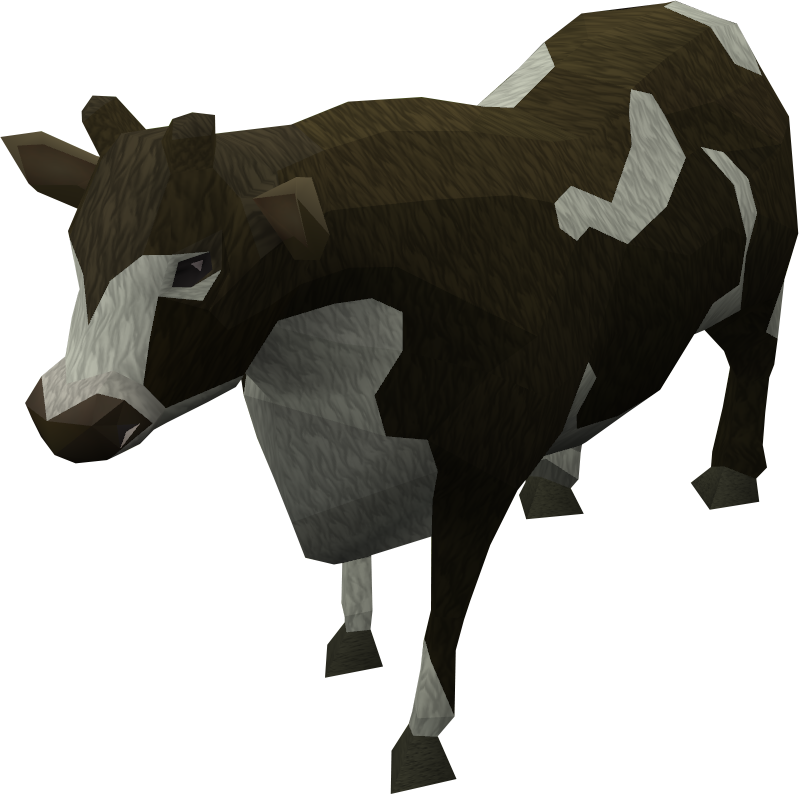
If you played Runescape, you know a thing or two about ore mining, bar smelting, spear fishing, gem cutting, leather tanning, flour milling, dairy churning, and possibly to your expense, scamming (not a technology, but ya).

3) Just.. things

What does it mean to "blow a raspberry"? What is a kebab? What are runes anyway? And of course there is plenty of nonsense logic as well.


And the things I may have encountered too soon for my age..


And the music. Although the MIDI is awful, the composition is very something. The modality really brings out the European medieval setting. It is nice to hear something else for a change that is not Ionian or Aeolian. I recognize some Lydian, Dorian, and Phrygian..

Just things.

I had gleaned all I could from the game. There is nothing more for me in that bubble. Headed back to reality ever since and called it an experience. 10,051,749 XP to be precise.

Really feeling this way (in real life) throughout high school life and towards university:


Maybe that is the most important thing I learned from Runescape. Got to embrace every waking moment. That XP is going to make a difference. So get out of that virtual world and get some real life XP.. and become some real life skill master. Unless you want to stay a noob.

Sunday, 23 August 2015

Neumes

Recommended prerequisite: music theory

For most people Bach is the oldest composer on their repertoire, who lived somewhere between the 1600s into the 1700s. In the mainstream the oldest things out there are probably Vivaldi or Pachelbel. There is nothing wrong with that. It is understandable that fairly modern techniques are not directly transferrable to the Baroque music style.

But this post is not about Baroque music (which is another story to itself). What if I told you that before Bach, even before the Renaissance, their music was written with square notes?


These square notes are neumes. Notice that there are four staff lines instead of five.. and there are no definite measures or tempo. Is this notation outdated, antiquated, primitive, or what? No, this comes to the same issue as Baroque music: the style is simply different.

This notation was often used for plainchant sung in churches. More important to understand is the purpose of plainchant. It was not so much for public performance than for personal prayer. Those European cathedrals had very deep echoes, so sounds delayed, overlapped and bounced back. In that environment there was no need for precise rhythmic notation.

Another quirk about neumes: there is no specified starting pitch. You get to sing with whatever "key" you like. Notice that four staff lines just about spans one octave, which is the average vocal range.

Brilliant. How to sing it?

An Idiot's Guide to Square Notes tells you everything you need to know! In fact it explains better than I can. I like how it explains that you would not notate a symphony with neumes any more than you would a Gregorian chant with modern notation, because the styles require different approaches. The two notations were even invented by the same person. Hur hur.

For a feel of how it sounds: https://www.youtube.com/watch?v=pqDIEjQfdNk

Why are neumes not getting much attention? Perhaps the religious background makes people wary? What I am more interested in is how this style of notation can change our mentalities towards music. Is there some potential we can rediscover from the freedom neumes provide?

Saturday, 22 August 2015

G Flute

Recommended prerequisite: music theory, physics

Four months ago I made a G flute from a flagstick.
This calculator takes care of drilling details: http://11wall-west.com/~ph_kosel/flutomat.html. These are the measurements I used:


The holes I made are ugly.. punctured with a sewing needle then “dug” out with pencil and scissors. There is no mouthpiece. The end is just flat like a straw. It is almost the same way ancient people put six holes into a segment of reed from a riverbank.

The way woodwind works is the stream of air must split in half. The recorder is easiest to play since the design splits the air for you. The modern flute is a little harder since you must aim at the edge (or maybe not, I never played one). As for my straw-like flute, it is quite something else..


The sounding concept of my flat brim flute is pretty much like a ney, which I learned from here: http://www.neyzen.com/ney_metodu.html. The technique is veeeeery hard. You are somehow supposed to split your airstream on the flat brim. A subtle twitch in lip shape, ney angle, or tongue placement is enough to extinguish the sound. As you can see I only managed three notes (D, E, F#) after trying for three months:


By the way, there is another sounding technique which requires wedging the edge between your two front teeth and hissing like a viper.. This Persian method creates a unique tone, but no thanks. The Arabic/Turkish method I am using is difficult enough.


Really, during the first three months I only produced air and wispy harmonics. As you may or may not have known from A Cringeworthy Process, I a not one to give up so quickly. This is recently, my fourth month trying:


I achieved two extra notes by overblowing the D and E to get their perfect fifths A and B. The fingerings are the same, but the stronger breath makes the second harmonic (perfect fifth) ring. For some insight to how it works, refer to Harmonic Intervals and Resonance and Timbre and Overtones. I can manage overblown octaves as well, but my breath transition needs some attention first. It is generally not recommended that I learn so many notes before mastering the sound quality.. still working on it!

How was the first flute inspired? My guess is an observation of wind flowing through an empty log. But from this flutemaking experience I find that flat brimmed flutes are really hard to play. Even after making the flute, it takes three months' effort to produce a sound (perhaps even longer for the first flutist ever, since there are no preceding flutists to teach the first). Either ancient people had nothing better to do, or they were increeeeedibly smart. I think they actually were smart.

Five notes (D, E, F#, A, B) is enough to play a couple songs but let me work my intonation first. Then I might play you something decent..

Saturday, 15 August 2015

Japanese Pagoda

Prerequisite: none

This is a Japanese pagoda from 700AD:


Japan has intense seismic zones. A couple of its earthquakes made headline news in the past. How come we never hear about fallen pagodas? Ever?

Because they don't. Pagodas don't fall. These buildings remain while modern innovations continue to crumble.

Construction secrets revealed here:
http://web-japan.org/nipponia/nipponia33/en/topic/

To summarize the article:
1) Wood is flexible.
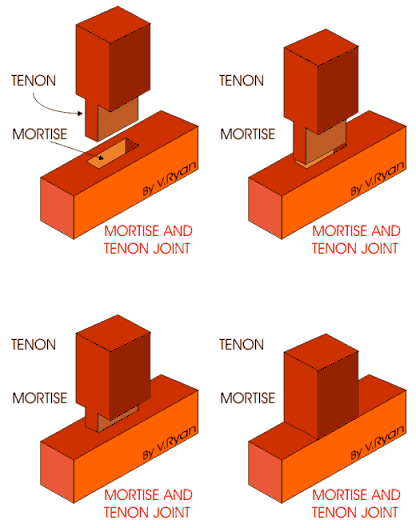
2) Tenon-mortise joints increase flexibility.
3) All levels are independent of other levels,
4) so that each level sways in counter balance
5) on a central pillar.


So there you have it. The pagodas were designed to absorb and shake out the shock. A Chinese idiom describes this very well: 以柔克剛. The literal translation is "to conquer hardness with softness". "To conquer force with yielding" sounds much better with our context.

 Profound eh.

Polynesian Navigation

Prerequisite: none

Many people are impressed that Columbus sailed across the Atlantic in 1500.

But consider this.

It is 1000 BC and you need a way to sail throughout the Pacific. You know nothing about compasses, massive ships, and telescopes. You do not even know of writing. How are you supposed to navigate the largest ocean on a canoe?

The Polynesians certainly found a way.
http://www.exploratorium.edu/neverlost/

This site gives details on how they construct canoes, read weathers, utilize stars, pinpoint latitudes, harness winds, measure traveling speeds, interpret wave patterns.. and much more! It is all very impressive.

There is even evidence of having sailed all the way to South America. Surely these people must have been somewhat sophisticated to have done such feats. How many people before the birth of Christ had managed to travel such distances in their lifetime? Not a lot!

I refuse to believe that interactions only happen across land. Despite being split on our standard world map, the Pacific is just as full of activity and exchange. There is a widespread something from Taiwan, to New Zealand, to Hawaii, and all the lesser known islands in between. When I think of the relation between Polynesian and Aboriginal Taiwanese sea culture, it opens to me a further curiosity for the forgotten islands on the Pacific.

I ought to find out more about these people..