Showing posts with label instructional. Show all posts

Sunday, 31 January 2016

Confuci-us

Prerequisite: none

As a Chinese, the translation of "孔夫子" (kongˇ-foo-zhi˙) to "Confucius" (kon-fyoo-shus) has always been somewhat confusing.. very kon-fyoo-sing indeed! The last syllable has puzzled many a Chinese. Why would "zhi˙" become "shus"?

I thought this quirky translation was unique to Confucius until I found out yesterday that 孟子 (mengˋ-zhi˙) is also known as "Mencius" (men-shus). It finally clicked when I searched "Suncius" (孫子, author of The Art of War) and it showed up in "Vicipaedia".


The "-us" at the end is a masculine suffix. Julius. Marcus. Brutus. Confuci-us. As for pronounciation in Ecclesiastical Latin:

1) C before O is a hard C (as in k)
2) U is pronounced "oo"
3) C before I is a soft C (as in ch)

The last U is probably a short "oo". So instead of "kon-fyoo-shus", it should be:
"kon-foo-chi-us"

And leads me to wonder.. what is my Latinized Archaic name?

First of all, Archaic Chinese. Females more commonly used "氏" (shiˋ), which they attached to their father's or husband's surname. Problem is, my last name is from my mother's side (special case) and I am not married yet. "子" (zhi˙) was used for respected or scholarly people, although the fact that it was more explicitly used for males was due to the lack of female scholars.

There are more choices but they get very specific about status and age, and are not convenient for public use. For my case I better use "子".

My surname is 孫, so 孫子.
I wrote The Art of War, whoopee~

On the Latin part, pick any female Latin suffix of choice. Let me see..

Suncia
Suncilla
Suncilia
Suncilea
Suncina
Suncilina
Suncianna
Suncissa
Suncietta
Sunciella

I would not go for more than three syllables because that just sounds too princess-like.

Suncia
Suncilla
Suncina
Suncissa

Maybe something not so "flowery".

Suncia
Suncissa

Ehh.. I would rather not name myself after some furniture. "Cissa" is actually a genus of magpies, but preferable.

Suncissa

Saturday, 14 November 2015

Cactus Chronicles

Prerequisite: none

This baby is coming home with me!


Wandered around Cicada Night Market, Hua Hin on a Friday night. Adopted this buddy for fifty baht. Barely half a pinky wide, with only a few white spots indicating where spikes will sprout. There were many bloomed cacti to choose from, but I am in for a surprise with this youngster.

The care is apparently very simple. Water once a week, to the point where water gushes out of the pot base. The cactus does not die abruptly but turns yellow or white first, so that there is time for saving. It needs some four hours of sunlight every day. I suppose a cactus can withstand drastic temperature changes as a desert's environment is such.

Great companion plant for lazy people like me. Go get one now~

Will update on a separate blog: Cactus Chronicles.

Saturday, 22 August 2015

G Flute

Recommended prerequisite: music theory, physics

Four months ago I made a G flute from a flagstick.
This calculator takes care of drilling details: http://11wall-west.com/~ph_kosel/flutomat.html. These are the measurements I used:


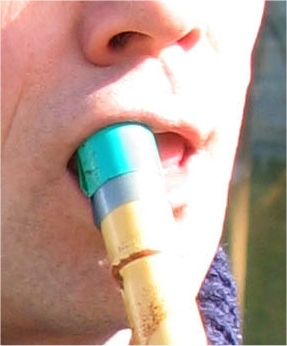
The holes I made are ugly.. punctured with a sewing needle then “dug” out with pencil and scissors. There is no mouthpiece. The end is just flat like a straw. It is almost the same way ancient people put six holes into a segment of reed from a riverbank.

The way woodwind works is the stream of air must split in half. The recorder is easiest to play since the design splits the air for you. The modern flute is a little harder since you must aim at the edge (or maybe not, I never played one). As for my straw-like flute, it is quite something else..


The sounding concept of my flat brim flute is pretty much like a ney, which I learned from here: http://www.neyzen.com/ney_metodu.html. The technique is veeeeery hard. You are somehow supposed to split your airstream on the flat brim. A subtle twitch in lip shape, ney angle, or tongue placement is enough to extinguish the sound. As you can see I only managed three notes (D, E, F#) after trying for three months:


By the way, there is another sounding technique which requires wedging the edge between your two front teeth and hissing like a viper.. This Persian method creates a unique tone, but no thanks. The Arabic/Turkish method I am using is difficult enough.


Really, during the first three months I only produced air and wispy harmonics. As you may or may not have known from A Cringeworthy Process, I a not one to give up so quickly. This is recently, my fourth month trying:


I achieved two extra notes by overblowing the D and E to get their perfect fifths A and B. The fingerings are the same, but the stronger breath makes the second harmonic (perfect fifth) ring. For some insight to how it works, refer to Harmonic Intervals and Resonance and Timbre and Overtones. I can manage overblown octaves as well, but my breath transition needs some attention first. It is generally not recommended that I learn so many notes before mastering the sound quality.. still working on it!

How was the first flute inspired? My guess is an observation of wind flowing through an empty log. But from this flutemaking experience I find that flat brimmed flutes are really hard to play. Even after making the flute, it takes three months' effort to produce a sound (perhaps even longer for the first flutist ever, since there are no preceding flutists to teach the first). Either ancient people had nothing better to do, or they were increeeeedibly smart. I think they actually were smart.

Five notes (D, E, F#, A, B) is enough to play a couple songs but let me work my intonation first. Then I might play you something decent..