Recommended prerequisite: art 1, physics
Hopefully this posts helps people learn music.. without learning music!
pitch - hue
timbre - saturation
dynamics - value
chord - colour
key - colour scheme
wheel of fifths - colour wheel
tritone - complementary colour
In terms of waves, pitch and hue correspond to frequency. The superposition of waves cause constructive and destructive interferences, creating distinct timbre and saturation (but timbre is less customizable than saturation, since it is a uniquely built in characteristic for each instrument). The amplitude of a wave is to dynamics and value.
A chord is a mixture of pitches like colour a mixture of hues, although not so much timbre and dynamics. A key tells what set of pitches and chords to use. The wheel of fifths describes relationships between chords as a colour wheel describes relationships between colours. A tritone is two pitches that make a lot of destructive interference (like complementary colours, two colours that decrease saturation) and has a lot of tension.
rhythm - pattern
meter - rhythm
rest - space
A meter cannot exist without a rhythm, as rhythm cannot exist without pattern (whut, confused?). Say in musical terms, you have this rhythm: ∆∆∆∆∆∆. With the same rhythm, you can create different meters such as ∆∆ ∆∆ ∆∆ and ∆∆∆ ∆∆∆, or even ∆ ∆∆ ∆∆∆ (although not common). Another example with ∆∆∆∆ is ∆ ∆ ∆ ∆ and ∆∆ ∆∆. Rest is simply a "nothingness".
texture - balance
articulation - texture
motif - shape
theme - form
structure - layer
melody - figure
accompaniment - background
instrument - medium
Texture is the relation between voices, regarding their distance and relative motion. Articulation is to texture, since you can make flaky textures with peppery notes and flowing textures with streaming notes. A motif is less than a theme, as a shape is a little less than a form, but a motif can still be a subject. A theme is more complete than a motif, as a form has more details that distinguishes itself from a shape. The structure describes the layers in piece of music, what comes first and next. An accompaniment is the backdrop for a melody.
There does not seem to be an equivalent for beat and tempo, as far as my little brain knows. The beat is a pretend drum that continuously taps the tempo, the speed of the music.
Even if you do already know these things, keep in mind that the best musician tries to exploit as many elements as possible. Noting these elements gives a handhold at expressing the idiosyncrasies of a piece. It is key to being an exceptional performer!
Showing posts with label visual art. Show all posts
Showing posts with label visual art. Show all posts
Saturday, 19 September 2015

The Adventures of Pig and Stickman
Prerequisite: none
Back in grade seven I had this IT assignment where we had to make a "how to" presentation with Prezi, and I made a "how to draw" presentation. Then I discovered its potential for storytelling..
The Adventures of Pig and Stickman
The Adventures of Pig and Stickman (2)
Pig and Stickman Christmas (2010)
The Adventures of Pig and Stickman (3)
The Adventures of Pig and Stickman (4)
So adorkable, I know!
I guess it was pretty original for a twelve year old.. even if the storylines are somewhat random. The second episode was probably inspired by Save the Sheriff. The third has a Courage the Cowardly Dog feel to it.
It is easy to make something dorky. Everyone has an inner dork I am sure. Nothing can go wrong with a little dorkiness. Have a go at Prezi! I did the drawings with the highlighter tool, but there are probably more features to exploit by now.
And for some reason Pig and Stickman started killing each other three years later in Ham vs. Man. I did not notice until now..
Back in grade seven I had this IT assignment where we had to make a "how to" presentation with Prezi, and I made a "how to draw" presentation. Then I discovered its potential for storytelling..
The Adventures of Pig and Stickman
The Adventures of Pig and Stickman (2)
Pig and Stickman Christmas (2010)
The Adventures of Pig and Stickman (3)
The Adventures of Pig and Stickman (4)
So adorkable, I know!
I guess it was pretty original for a twelve year old.. even if the storylines are somewhat random. The second episode was probably inspired by Save the Sheriff. The third has a Courage the Cowardly Dog feel to it.
It is easy to make something dorky. Everyone has an inner dork I am sure. Nothing can go wrong with a little dorkiness. Have a go at Prezi! I did the drawings with the highlighter tool, but there are probably more features to exploit by now.
And for some reason Pig and Stickman started killing each other three years later in Ham vs. Man. I did not notice until now..
Monday, 14 September 2015
Gee
Prerequisite: none
If you would like to know the Blue Giraffe a little more, here are some comics I did over the past couple months: https://drive.google.com/open?id=0B7EA2CwmDWk4d18zN3o3VU9oNlk
Check "details" for each PNG where I might have added a comment in the "description". Set list order to "last modified" to know whether I uploaded a new comic or not. There may be month gaps without activity but hey, I am a busy person~
There are a couple motivations for making these comics. One is to share amusing random thoughts. Not necessarily stomach splitting, but amusing. Another is to introduce my little Blue Giraffe world. It is not something that can be explained, but it can be shown. And lastly, to show that I do have a sense of humour. I am not particularly known among my peers for being playful. I should be able to say that even if my sense of humour is lame, at least I have one..
Just go read some. A picture is worth a thousand words.
Anyone can do a comic. It does not take great artistic skills (as demonstrated by Rage Comics). If you can find a reason why you might want to draw one, take a shot. Like video games, you are telling a story. So why not. Tell your story.
If you would like to know the Blue Giraffe a little more, here are some comics I did over the past couple months: https://drive.google.com/open?id=0B7EA2CwmDWk4d18zN3o3VU9oNlk
Check "details" for each PNG where I might have added a comment in the "description". Set list order to "last modified" to know whether I uploaded a new comic or not. There may be month gaps without activity but hey, I am a busy person~
There are a couple motivations for making these comics. One is to share amusing random thoughts. Not necessarily stomach splitting, but amusing. Another is to introduce my little Blue Giraffe world. It is not something that can be explained, but it can be shown. And lastly, to show that I do have a sense of humour. I am not particularly known among my peers for being playful. I should be able to say that even if my sense of humour is lame, at least I have one..
Just go read some. A picture is worth a thousand words.
Anyone can do a comic. It does not take great artistic skills (as demonstrated by Rage Comics). If you can find a reason why you might want to draw one, take a shot. Like video games, you are telling a story. So why not. Tell your story.
Sunday, 6 September 2015
The First Image
Prerequisite: maybe psychology. Actually nah, you are too smart for psychology.
A big question in Art History class came about: how did the first drawn image come to be? How did it occur to the first human, to join some lines on a surface, and make believe that it is a "thing"? I have an idea. Just an idea.
Gestalt Psychology explains (partially) how humans interpret the light signals from our eyes as images. Here are some principles:
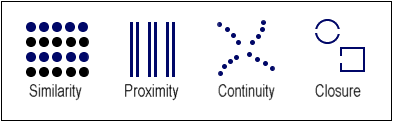
Similarity: similar things are the same "thing"
Proximity: close things are "together"
Continuity: let us pretend that the dots are connected
Closure: let us pretend that the shapes are bound
These are instincts that we take for granted. And since these psychological reactions are built into our brains, it probably is not so weird after all for the first drawn image to come about. See this:
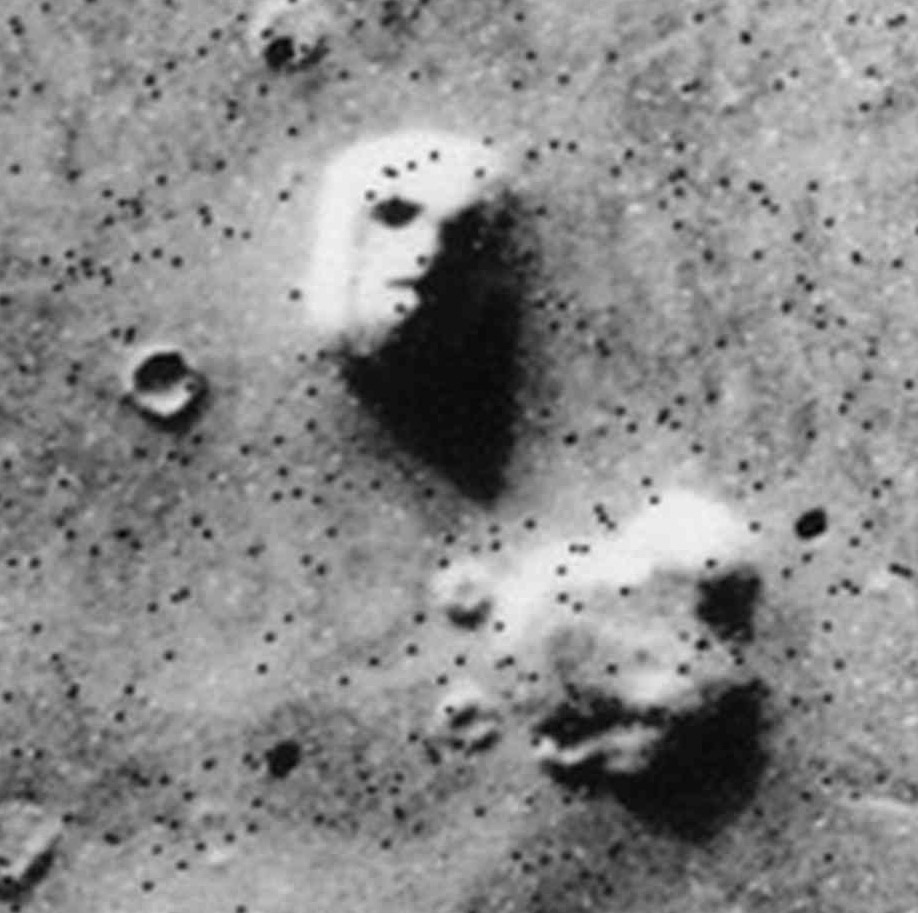
Do not deny it.. I know you see it! You see a face on the surface on Mars. You know very well it is not a real face, but you applied similarity (the whole bump is one rocky material), proximity (the surrounding craters are too far to take into account), continuity (the features align to express a face), and closure (despite the shadow, you assume that the face is bound). We have such strong Gestalt instincts.
Going back to how the first drawn image came about, a possible answer occurred to me one night. Humans loved naming constellations. This art is in most cultures I can think of, even if their star-object associations are not the same (almost like a Rorschach test). Without light pollution, ancient night skies were full of stars and planets, and according to Gestalt Theory.. humans cannot help but connect the dots! Say, you cannot possibly not see an image in this randomness:
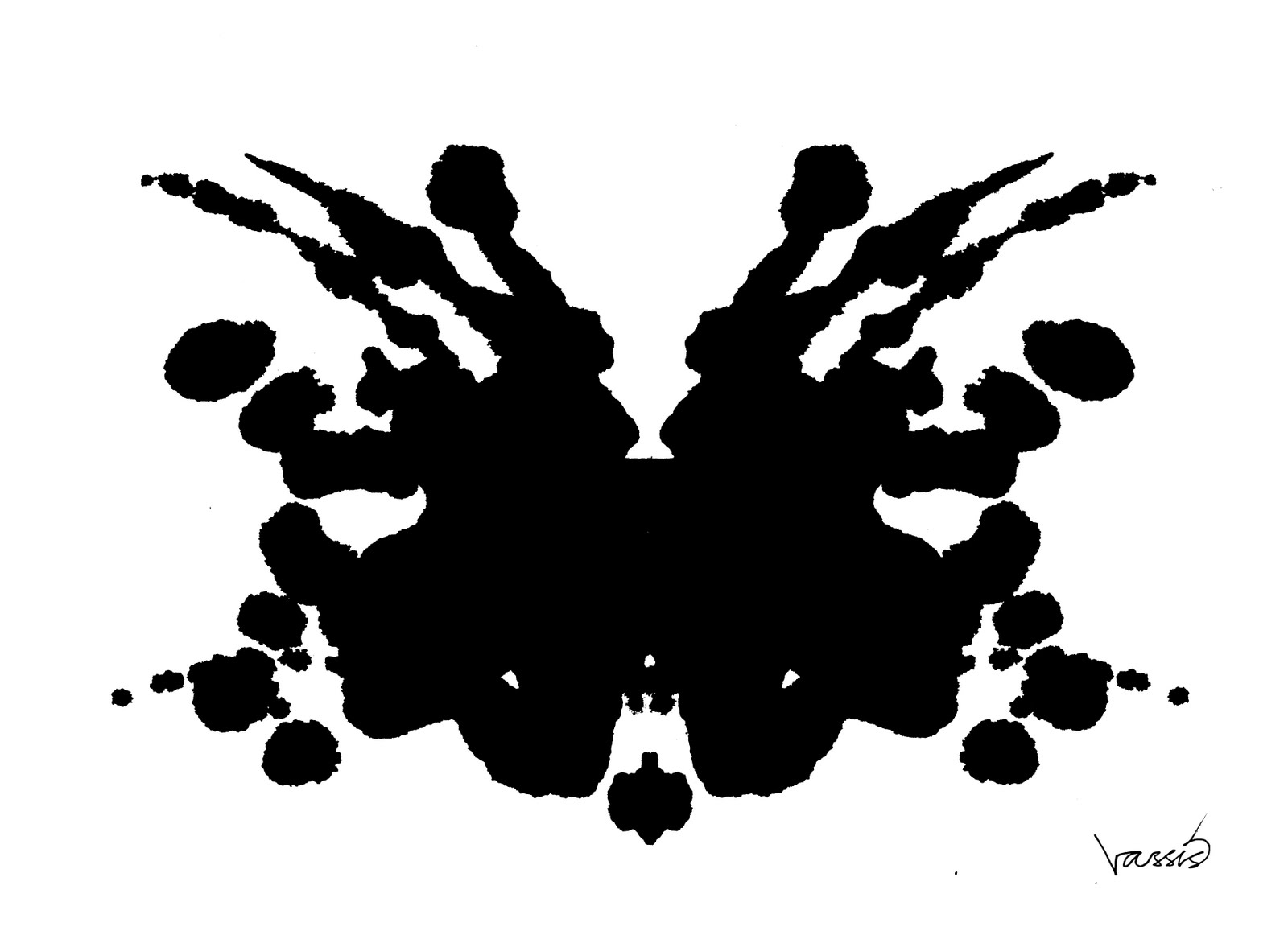
And with so many dots.. someone put some order to this madness! First apply similarity (brightly glowing dots appear to be the same thing, and indeed they are stars), proximity (close stars are one group), continuity (chains of stars make lines), and closure (connect star chains to make shapes). Then name it something that it resembles.

(By the way, I had some fun with Planetarium. I knew when to see Venus, Mars, Jupiter, and Saturn over my suburban house. Stellarium goes even further with more deep space features and cultural perspective. That might be another story to post if I get myself to understand those technical terms and figures).
Before every artwork comes inspiration, and the night sky could have been the first canvas which inspired humans to connect some lines or objects. Or perhaps humans first observed the clouds, or some bumpy rock surface, then sought to sift some sand or chip some rocks. One way or another, nature was the vey first inspiration, and humans learned from this master creation.
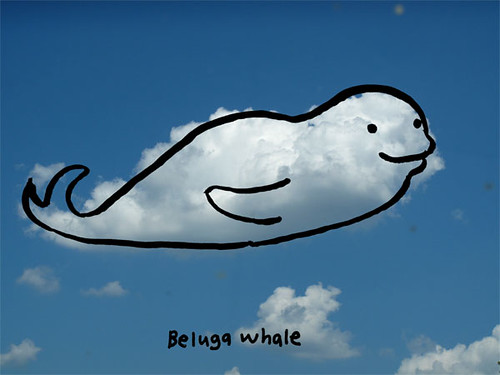
Art is probably unavoidable. Even if you do not draw your idea, you still think it. It is there.
Sunday, 16 August 2015
A Cringeworthy Process
Recommended prerequisite: art 1 (I never took it either, so no worries)
When I ask someone, "Why don't you try to draw something?", the replies are always something along the lines of "I am not good at it".
I guess it is nice for others to know about my successes, but perhaps it is more important for them to know about my failures. And I can assure you that failure happens more often than success.
If you ever hear three minutes of perfection at the piano, understand that it took three years of failure to get there. No exaggerating. Sometimes I had to run a measure fifty times over (not that I counted) in order to get it right. Sometimes I had to put a piece off for a couple months so that I might build the required skills before returning to it.
To prove my point here is a not-so-flattering watercolour from grade 8 (I am cringing so hard right now):

The background is supposed to be one smooth gradient. The object spacing is awful. Stark crooked linings, little hue diversity.. and for some reason I left a lot of white edges (still combating the habit now). If there is anything presentable about this, that is because the teacher fixed it for me. I am facepalming so hard right now. Hur hur.
You have no right to say that you are no good at something, until you have tried the following:
1) Give yourself a second chance. It surprises me how many people become dismayed at their first attempt. Really, if your first attempt at something is a masterpiece then you must be a genius. But you are not, and I am not, so we need second chances. Forgive yourself for not being born a genius. Let go of pride.
This was what I was trying to portray:

And here is my first attempt at the bottlemouth:

This is me in the summer of 2015, my first time glazing. Wow so lifelike *cough cough*. There is no hint of transparency or reflection whatsoever! Yuck.
I may have gained some art experience over the last three years, but none from a proper classroom setting, and none with a brush. This is my second watercolour since grade 8 (my first is just a few months before this) but that was not enough to make me "fluent". Of course my first glazing sucked. I would not be surprised to know that your first glazing sucked too.
2) Focus on one section at a time. How do you expect to do the whole thing if you cannot even do a half, a quarter, or one tiny portion? Do not let this process discourage you. If you need to minimize the portion, do what you need to do. Since I did not do the bottlemouth too well, I did repetitions. All ellipses are so off, and the fuzz is so grotesque I just want to crawl into a hole.


Note that you are not just doing blind repetitions, otherwise you will be "practicing your mistakes"! What you are doing is not exercising a procedural memory, as psychology suggests. You are trying to overcome a mental block. Practice is as much thinking as doing. You cannot practice without one or the other. I did one bottlemouth a day and took four hours with each (estimate), thinking a whole lot before my next layer of glaze (I could afford to spend so much time only because it was the summer holidays).
3) Listen to counsel. Experienced people know what you need. If you ever wondered how you can achieve something, they have the answers. To ditch their suggestions is to do exactly what keeps you from succeeding. If someone tells you that in 2x = 1, x = 1/2, and you insist that x is anything but 1/2.. good luck in finding a solution.
This bottlemouth is significantly less fuzzy than my previous ones but according to my mentor, this is not enough (if I had shown him the ones before this it would have made him foam at the mouth, or perhaps gave him cancer). There may have been more that he would like to point out but at least he was honest enough to catalyze the progress you see throughout this post. Otherwise I would be stuck at stage one.

Perhaps I still have issues with my lines, but I agree that fixing this problem will bring me to a whole new level. Maybe I should practice some lines, just lines, and try to overcome my mental block..
What I cannot show you is how I agonized to capture a decent-enough photo for this painting. The photos were long trashed but I can tell you that I submitted five or so photos to my mentor, and captured ten times more photos than I submitted (estimate). The process was a whole week to itself, just to get the one photo for this painting. If I had listened more closely it would not have taken so long.
But then again, if my first shot was perfect I must be a genius.
4) Do not worry about comparing yourself to others. "When I see how amazing they are, I just want to give up". This is one of the most common problems people face. Don't get me wrong, comparison is okay. Comparing the work is good for finding influence, but comparing the people does nothing to help you improve.
So what if someone is younger? Guess what, you will only get older, and today is as young as you will ever be. Get working today while you still have the strength in your limbs and the plasticity in your brain. Do you mean to stay idle for the rest of your life just because someone else is better? So what if someone is better? There will aaaaalways be someone who is better. I do not intend to live my next sixty years without trying anything new, well do you? Are you really going to give up now, and live without it for the rest of your life? So what if someone took up the skill later than you did but still does better than you? That person certainly did not waste time comparing!
(Sorry for the rant)
More importantly, reconsider why you are doing this. Am I painting because I want to earn other people's praises? If the only reward you seek is superficial, you will not get very far. Or am I painting because I like to paint? Sure the process is gruelling, but I do like to create all things pleasant! Then that is what matters. Do something for the sake of doing it, and not for other people's approval. Have some intrinsic motivation.
Rather than wasting time on how people perceive you, why not refine your work so that you do not even need to worry about their perception? Treat the disease, not the symptom.
I have never seen what an art 1 student's work is supposed to look like. Nor do I try to find out. All I relied on was my mentor's feedback, some exemplars, and an honest self-critique. This is a bottlecap on a jar lid.

There is not enough contrast for highlights to stand out. Lines are still fuzzy. The lid is not even properly elliptical. It looks like a dead oyster. I had no idea how an art 1 student should do, but I was determined to fix it.
5) Be patient. At this point in time I had already spent away one month of my summer holidays. And yet I had not started my official canvas. This trial took me a week or two.

The letters do not follow the curve. There are not enough reflections on the jar. The banana has a funny pallor. The marble is not splotchy enough. The wall is too yellow. I am glad to have spent the extra week.
The official took some three weeks. If I had only shown you this, you would be misled to think that this is what you should be able to do on your first attempt. But that is not the case. I had to endure a month of failure.

Of course this is by no means perfect. The table line does not seem to make sense. There is something eerie about those cinnamon sticks. There is something not so convincing about the thermos flasks. The blue bottle at the back is rather stripy. The puddles on the pink jar are awkward. The bottlecap does not look like it fits on the bottlemouth. The axes of the bottle do not match. The splotches on the marble are not quite the right shape..
And my damned lines. Always. Squiggly, fuzzy, drunk lines.
But I am not cringing. At least, not yet..
When I paint now I still cross my fingers and hope that my lines will turn out presentable. It should not feel this way. I know for a fact that I do not "hope" that the intonation of my violin will sound right. If I practice enough I will have more control and confidence. This is not the end of the climb. Actually, there is no end to the climb. So there is no reason to be disappointed that you have not reached the top. This is why you should enjoy the climb, and not feed on praises regarding your climb. Intrinsic motivation.
My goal for the next three years is to be able to look back at this painting, cringe really hard, and crawl into a hole. Truly, that would be a sign of progress.
I still laugh at this.
It is cringeful. It is worthy. It is cringeworthy.
In summary:
1) Give yourself a second chance.
2) Focus on one section at a time.
3) Listen to counsel.
4) Do not worry about comparing yourself to others.
5) Be patient.
Unless you have done all of the above, I forbiiiiid you to say that you are "no good" at something!
Friday, 14 August 2015
Omniglot
Prerequisite: none
Wondrous site: http://omniglot.com/
"The online encyclopaedia of writing systems and languages".
So what?
I knew that many minor languages exist, but this collection blew my mind. There are sooooo many languages and scripts within the neighbourhood of one region. It is also interesting to compare between proximally close languages.
Above all, foreign scripts are just so pretty. How many of us are aware that there are writing such as these in northern China? Or even that Manchurians have their own script?
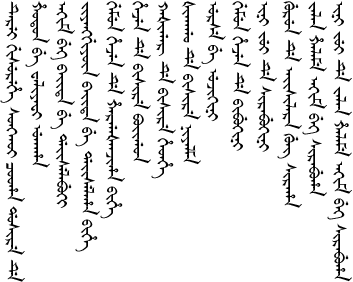
Some pages to get started:
http://omniglot.com/writing/types.htm
Difference between abjad, abugida, alphabet, syllabary, and semanto-phoenetic writing systems.
http://omniglot.com/language/articles/index.htm
Articles, articles, and articles. About anything really.
http://omniglot.com/writing/direction.htm
Writing directions can be so odd you just have to see it to believe it.
The Ancient Berber script (in Morocco) runs from bottom to top.. hurhur!
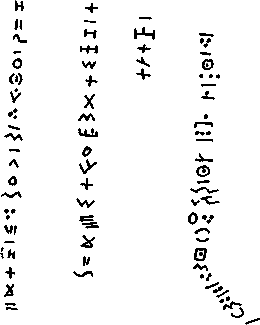
Language is one of the many aspects of life that we take for granted. It is strange to think of the voices we never get to hear, of the records of past civilizations that are no longer intelligible, or simply legacies that no longer exist.. as well as current cultures that are heading down this path.
Wondrous site: http://omniglot.com/
"The online encyclopaedia of writing systems and languages".
So what?
I knew that many minor languages exist, but this collection blew my mind. There are sooooo many languages and scripts within the neighbourhood of one region. It is also interesting to compare between proximally close languages.
Above all, foreign scripts are just so pretty. How many of us are aware that there are writing such as these in northern China? Or even that Manchurians have their own script?
Some pages to get started:
http://omniglot.com/writing/types.htm
Difference between abjad, abugida, alphabet, syllabary, and semanto-phoenetic writing systems.
http://omniglot.com/language/articles/index.htm
Articles, articles, and articles. About anything really.
http://omniglot.com/writing/direction.htm
Writing directions can be so odd you just have to see it to believe it.
The Ancient Berber script (in Morocco) runs from bottom to top.. hurhur!
Language is one of the many aspects of life that we take for granted. It is strange to think of the voices we never get to hear, of the records of past civilizations that are no longer intelligible, or simply legacies that no longer exist.. as well as current cultures that are heading down this path.
Subscribe to:
Posts (Atom)